Did you know there are three main types of flue you can have with your freestanding wood-burning fireplace? The choice you make depends on the age of your home, how it was built and where your home is located. Understanding how each system works and which one you need can save you a lot of hassle down the road.
In this guide, we’ll look at the three core flue systems, SFS, IFS and AFS+, covering how each works, who they’re best suited for, and which one you should choose. If you’re in a period home in inner Melbourne or building new in the suburbs, you can have a wood burning fireplace and enjoy that sense of comfort and warmth only wood can bring.
How a Fireplace Flue Actually Works
Before we get into the nitty gritty of different kinds of flues, let’s look at how all flues work. The function of a flue is to vent smoke, toxic fumes and gases that a fire creates, safely out of your home.
When the fireplace is lit, the heat from the fire naturally rises inside the stainless steel flue liner. This in turn creates a vacuum inside the firebox that will draw air in to replace it and feed the fireplace the combustion air it needs.
To keep the home safe from the extreme exhaust temperatures, flue systems are designed with additional layers of steel or insulation which is designed to shield combustible surfaces from unsafe temperatures.
There are four key parts to a flue system:
The Active Flue: Stainless steel that is responsible for the primary exhaust
The Outer casings: Stainless steel or galvanised casings for shielding combustible surfaces or areas from the extreme heat
Ceiling Ring: To cover the ceiling penetration whilst maintaining the clearance requirements to combustible materials.
Cowl: A cover at the very top of the flue that keeps rain out of the active and outer casings of the flue.
SFS: The Standard Flue System
The standard flue system is an air-cooled, triple-skinned venting set up. It uses natural convection, the hot air rising brings in cold air to fill the vacuum, to safely exhaust the smoke while keeping the outer chimney pipe cool to the touch.
The SFS works through the draft principle, described above. The heat from the fire warms the air. This rises up through the inner flue, bringing the smoke and extras with it. This creates a vacuum, which draws cool air in below, both feeding the fire and feeding the draft. It helps to have a window open somewhere in the house to ‘refill’ the cold air in the house.
An SFS uses three concentric casings in the flue. The innermost pipe carries the hot air and smoke and gases up and out, while the surrounding outer layers use ambient air drawn from the room, to keep the outer shell cool to the touch.
This cooler shell allows the chimney to safely pass through the roof space without heating or possibly combusting the material inside the roof cavity.
IFS: Enhanced Efficiency
The VisionLINE Insulated Flue System (IFS) uses a 25mm layer of CE-certified Morgan Ceramic insulation between the active and outer casings. This insulation blanket is tested to withstand temperatures above 1,750°C, allowing for minimal clearance while keeping the outer skin cool as it passes through combustible areas.
Paired with an insulated ceiling ring, this creates a fully room sealed system. Rather than relying on ventilated skins to manage heat, as traditional air cooled flues do, IFS traps and retains that heat within the flue itself. This stops warm room air from escaping up through the flue and out of the house, keeping more of the heat your fireplace generates where it belongs, in the room.
The system also delivers a consistent pipe size, 150mm active and 200mm outer, from the fireplace spigot right through to the cap. Constructed entirely from stainless steel with a powder coated, high-temperature black finish, it holds up well in coastal or salt-exposed environments while giving your roofline a clean, modern look.
AFS+: A Room-Sealed Flue for Modern Homes
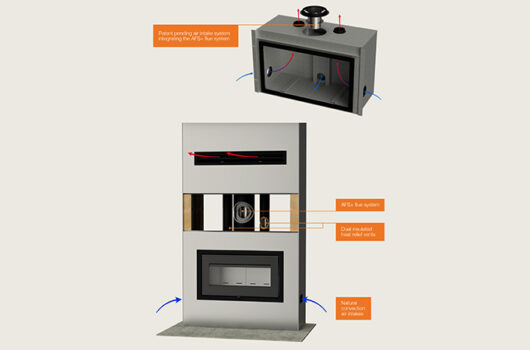
SFS flue would be found in older homes with more traditional fireplaces. An AFS+ (Air Flue System) is a sealed system that vents the combusted gases out, while preventing indoor air from being lost up the chimney. It has an advanced, insulated coaxial design that features an inner active pipe wrapped in high-grade ceramic insulation and an outer casing with a dedicated air gap. Instead of using indoor air, it draws fresh combustion air directly from the outside.
Benefits for Modern Homes
No Heat Loss: An AFS+ seals tightly at the ceiling, preventing warm air from escaping or cold drafts from entering the home.
Higher Efficiency: Increases a wood heater’s heating output and can reduce firewood usage.
Airtight Compliance: Perfect for modern, energy-efficient, or passive homes that require tight building envelopes without competing for indoor oxygen.
Noise Reduction: Cuts wind noise and rattling by up to 90% compared to traditional loose-casing flues.
Bushfire Safety: Highly rated for stringent Australian bushfire safety requirements, including BAL-40 and BAL-FZ levels.
SFS vs AFS+ vs IFS: Key Differences at a Glance
Here is a table so you can see key differences between the range of flues available at Jetmaster Heat & Glo.
Feature
SFS (Standard)
AFS+ (Air Flue Plus)
IFS (Insulated FLue System)
Flue Type
Triple-skin, air-cooled
Coaxial, ceramic-insulated
Ceramic-insulated single flue (25mm Morgan Ceramic between active and outer casing)
Fireplace Setup
Freestanding or traditional brick masonry chimneys
Freestanding high-efficiency heaters
Freestanding and inbuilt wood heaters passing through combustible areas
Combustion Air Source
Drawn from inside the room
Drawn from outside (Balanced flue)
This depends on the fireplace, this type of flue doesn’t integrate air intake
Room Heat Retention
Lower (Loses room heat to cool the flue)
Excellent (No indoor air loss)
Excellent (room sealed via insulated ceiling ring, prevents heat loss through outer casing)
Noise Reduction
Baseline (Can rattle or amplify wind)
Up to 95% reduction in outside wind noise
Up to 95% reduction in outside wind noise
Bushfire Rating
Standard compliance
BAL-40 and BAL-FZ (Flame Zone) approved
BAL-FZ (Flame Zone) approved
Best Suited For
Older homes, budget retrofits
7+ Star energy-rated & passive homes
Coastal, weather-exposed, and noise-sensitive installations needing a clean rooftop finish
Which Flue System Is Right for Your Home?
Let’s lay out the pros and cons of each of the three systems, and what they’re best for. This should help you understand which fireplace suits your home and lifestyle best.
SFS (Standard Flue System)
These are best for older homes, or period homes. Also good for those on a budget.
PROS: Lower upfront costs and reliable performance. They also have that sense of tradition of an open fireplace, crackling away.
CONS: Pulls air out of your living space to feed the fire, which can reduce the efficiency of overall home heating.
AFS+ (Air Flue System Plus)
This is an advanced, insulated system that has a specialised ceramic thermal barrier. It pulls air from outside your home, rather than syphoning from your living space. These types of flues are best for new builds looking for 7+ stars on efficiency. They’re also very good for bushfire zones.
PROS: Room sealed to stop cold drafts and loss of indoor heat. Reduces exterior wind noise as well.
CONS: high initial investment costs compared to SFS.
Choosing the Right Flue for Your Home
Choosing between SFS, AFS+ and IZC comes down to your home, your budget and where you’re located. If you’ve got a period home or you’re working within a tighter budget, SFS remains a reliable, time-tested option. If you’re building or renovating a modern, energy-efficient home, particularly in a bushfire-prone area, AFS+ or IZC will give you far better performance, efficiency and safety compliance. IZC in particular opens up design flexibility that simply isn’t possible with a traditional flue, letting your fireplace sit flush within the home’s structure rather than needing a separate, bulky hearth.
Whichever system suits your circumstances, getting the flue right is what separates a fireplace that performs beautifully from one that causes years of frustration.
Not sure which flue system is right for your home? Visit our range of flue systems online, or drop into our Richmond showroom at 444 Swan St to see them up close. For custom builds and bushfire-zone requirements, check out the VisionLINE IZC or get in touch with our team for tailored advice.
 444 Swan St, Richmond, Melbourne, VIC 3121, Australia
 Sales: 1300 219 875